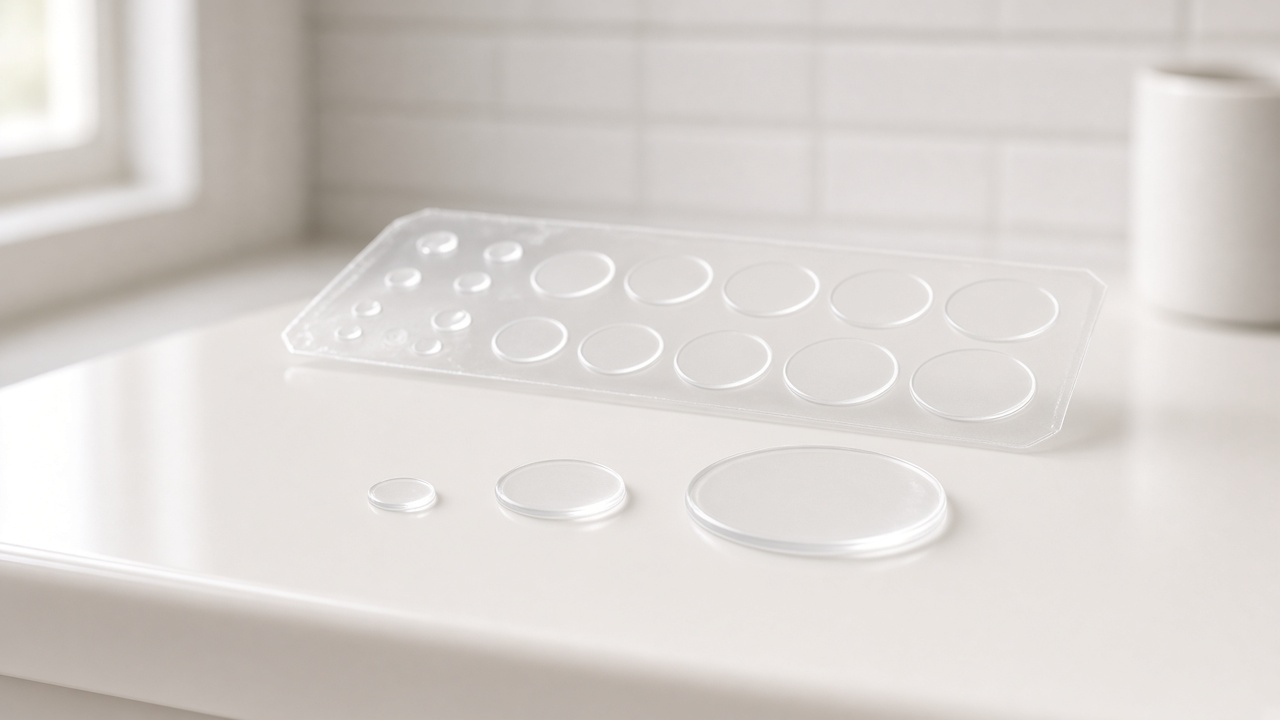
You have a whitehead, or a spot that is already open, and a sheet of clear discs. The job is to peel the size that covers that spot and still leaves a rim of clean skin. A disc that is too small lifts. A disc that is too big fights a fold. One everyday size is enough only when your spots are already that diameter.
Hydrocolloid is the cheap round dressing, roughly 15–40p a disc. It collects fluid that is already on the surface. A closed early bump is a microdart job, typically £0.60–£2.50+ a cone. Check the retailer. Anything deep, painful, cystic, or recurring needs a GP, not a bigger sticker. A larger disc is still a surface dressing. It is not a cure. If you are still choosing a format, use the hydrocolloid vs microdart comparison.
Cover the spot, then leave a rim
Look at the spot before you look at the box. The middle of the disc sits on the fluid. The sticky edge needs dry skin all the way round. That rim is what holds overnight.
Too small, and the edge sits in the fluid. The middle can turn white while the rim lifts. Too large, and the spare film creases beside the nose, in a chin fold, or under the arm of your glasses. The patch peels from that crease.
You do not need a ruler. If you can see skin around the spot once the disc is down, the size is about right. If the spot reaches the edge, take it off and use the next size up. You use each disc once. Do not restick one you have already peeled. The press-and-leave steps are in the overnight apply guide.
A small disc for a crease
A tight place wants the small disc. Beside the nose. In a chin crease. At the edge of a nostril. A large circle will not lie flat there. It buckles, and the buckle lifts.
The small disc still needs a rim. A tiny dot on a wide whitehead is too small. Leave it on the sheet.
Small discs also get used on a closed bump because they look neat. Size does not change the job. If there is no surface fluid, a small disc stays clear after a proper night. That is a format clue, not a sign you needed a bigger sticker. The unchanged-bump guide is that morning.
An everyday disc on a flat cheek
A cheek whitehead, or a small open spot on flat skin, is what the everyday disc is for. Press the middle, then the rim. Leave it for six to twelve hours, or overnight, if the edge stays down.
One repeated size is the simple buy when your usual spot already fits. Mighty Patch Original is that pack: one everyday diameter, 36 times. It is a poor fit if you keep folding the disc into a crease, or you keep seeing the spot at the edge.
A white or cloudy centre means the disc collected fluid. Still clear, after a night it stayed on, means there was little on the surface. The size can be right and the format still wrong. The colour is in the white-centre guide.
When one size is not enough
One size fails when the spots on your face are not one diameter. A chin crease and a cheek whitehead are not the same circle. A box of only the everyday disc leaves you folding, or leaving a gap. A sheet of only tiny dots leaves the cheek spot with no rim of dry skin.
A mixed sheet is the ordinary answer. Peel a small disc for the crease and a larger one when the spot needs a border. COSRX Master Patch is 24 discs of different diameters on one film. If you never peel the tiny dots, the 24-count is smaller than it looks. Pack notes are in the COSRX vs Mighty Patch guide.
The same test applies on a Boots or Superdrug own-label card. If every disc is smaller than your usual spot, you will leave most of the sheet unused.
One size also fails on a wider open spot, and on the back or chest, where clothes need a broader rim. A shirt or a bra band will roll a disc that only just covers. Clothing and reach are in the back and chest guide. A bigger disc still covers one spot. It will not cover a scatter of spots.
Do not overlap two small discs to make a larger one. The join is a ridge. A pillow or a collar rolls it off. Use one disc that covers, or wait until you have that size. Do not cut a round disc smaller. A cut edge lifts. Peel a size that already fits.
Dry skin still decides the hold
The right size on damp skin, or on moisturiser, still comes off. Wash the spot. Skip moisturiser, serum, oil, and SPF on that exact place. Press the middle, then the rim.
A shower or a wet face undoes the glue on a small disc and a large one the same way. If the patch is on the pillow by morning, check the skin was dry and the rim was clear of fluid before you switch size. The peel-off guide is that check.
Where to buy in the UK
Hydrocolloid is the cheap format: roughly 15–40p a patch, though pack prices move. COSRX Master Patch (Amazon UK) is the 24-patch mixed-size sheet, often listed around £5.99. Superdrug is the other named path. Check the retailer on the day. Mighty Patch Original is one everyday size in a 36-pack, typically listed around £10–12, with Boots often nearer £8.79 / 36, plus Hero UK and Tesco. Stockist notes are on where to buy hydrocolloid patches.
More size and pack notes sit in all guides. If you are still choosing a format rather than a diameter, start with hydrocolloid vs microdart.