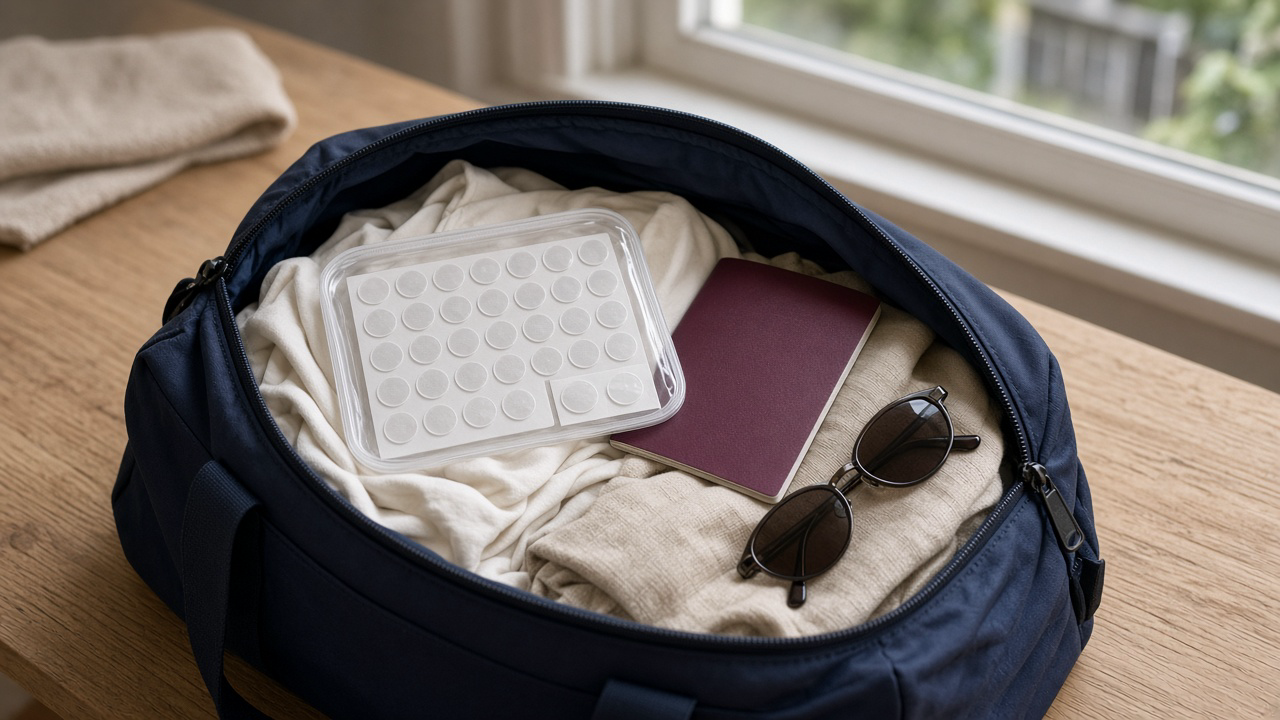
The job before you zip the bag is small. You want a few spot patches that still stick when you land, and you do not want unused discs stuck inside a washbag. Heat, steam, and peeling them too early are what waste them.
Pack the format you will actually use
Hydrocolloid is the cheap round disc, roughly 15–40p a patch. Pack it for a whitehead, an open spot, or anything already weeping. It collects fluid that is already at the surface. It does not flatten a closed bump.
A microdart is the dissolving cone for a closed early bump, typically £0.60–£2.50+ each, so check the retailer. Take one or two only if you already get those bumps. A crushed cone under a shampoo bottle is the dear mistake. Deep, painful, cystic, or recurring spots are a GP visit, at home or away. A patch is not a cure. If you are still choosing, start with hydrocolloid vs microdart.
For a short trip, take the hydrocolloid sheet. You can spare a folded disc. You cannot spare a crushed cone. See the microdart apply guide before you open one away from home.
Hand luggage, not the liquids bag
A spot patch is a solid dressing. It is not a cream, a gel, or a liquid, so it does not need a slot in the clear liquids bag. Keep the sheet, or a few discs still on their backing, in your cabin bag. A hold suitcase is where bags get crushed, or sit in the sun on a stand.
Leave scissors at home. A fingernail lifts the film, and cabin rules are tight on blades. Do not drop loose discs into a pot of moisturiser to save space. Cream on the glue is why the first night fails. A small pouch in the top of the cabin bag is enough.
Heat in a car, a hold, or a sunny room
The usual failure is the glue, not the flight. A sheet on a dashboard, a coach window, or a hotel sill can go soft. Discs stick to the film, to each other, or to the pouch, and you will not peel a clean circle off them.
Keep the pack in the main part of the bag. Do not leave the washbag in a parked car, or a hold suitcase on a hot stand. That is why the sheet belongs in the cabin. A chilly bag does not spoil a disc. Let it warm to room temperature before you peel, so the circle does not tear.
Unused discs: leave them on the sheet
Peeling a row “so they are ready” is how unused discs get wasted. A disc off its backing has one chance left, and a washbag is a poor place to wait. Fluff, powder, moisturiser, and SPF land on the glue. The disc looks fine later and will not hold.
Leave unused discs on the sheet, under the plastic film, until the spot is in front of you. If the sheet is wider than the pouch, fold it so the sticky side stays covered by its own film. Do not stack two peeled discs. They become one lump, and both go in the bin.
A partly used sheet is the useful cabin pack. Mixed sizes cover a crease or a wider rim. One everyday size, such as Mighty Patch Original at Boots, is enough when that diameter already fits. Leave the rest of a big pack at home unless the trip is long.
Leave each microdart cone sealed until the bump is there. A cone pressed flat in the pouch is money already spent. Wear time is in how long to leave a spot patch on.
A hotel bathroom is still a bathroom
The flight did not change how a disc sticks. Hotel bathrooms steam up, and that is where people rush. Wash the spot, step out of the steam, and wait until that skin feels dry. Skip moisturiser, serum, oil, and SPF on that exact circle. Press the rim, not only the middle. If the first disc folds, bin it. Hydrocolloid is single use. The same order is in the overnight apply guide.
A white middle means the disc collected fluid. Still clear, after a proper wear, often means there was little fluid there. Colour is in the white-centre guide. A closed bump is the wrong format, which the unchanged-bump guide covers. If you are damp, wait. Hold through water is in the shower and sweat guide. Makeup goes over a dry disc, not underneath. That is in spot patches under makeup.
How many to take
Count nights. One surfaced spot might need one disc a night, and a second if the first lifted. A long weekend is a handful, still on the sheet. A fortnight can take the rest of a 24-patch sheet.
One closed bump needs one cone, plus a spare only if another is likely. Six cones “just in case” is how a dear patch gets crushed. If you already picked a spot, a disc can cover what is open. It cannot undo the squeeze. That case is the picked-spot guide.
Where to buy in the UK
Buy before you fly if you can. An airport shop is a poor place to compare a sheet. Everyday hydrocolloid is roughly 15–40p a patch, though pack prices move. COSRX Master Patch (Amazon UK) is a 24-patch mixed-size sheet, often listed around £5.99. Peel the size you need and leave the rest on the film. Superdrug is the other named path. Check the retailer on the day. Mighty Patch Original is one everyday size in a 36-pack, at Boots, Hero UK, Tesco, and Amazon UK. Stockist notes are on where to buy hydrocolloid patches. Cone shops are on where to buy microdart patches.
More notes sit in all guides. If you are still deciding between a cheap disc and a cone before you pack, use hydrocolloid vs microdart.