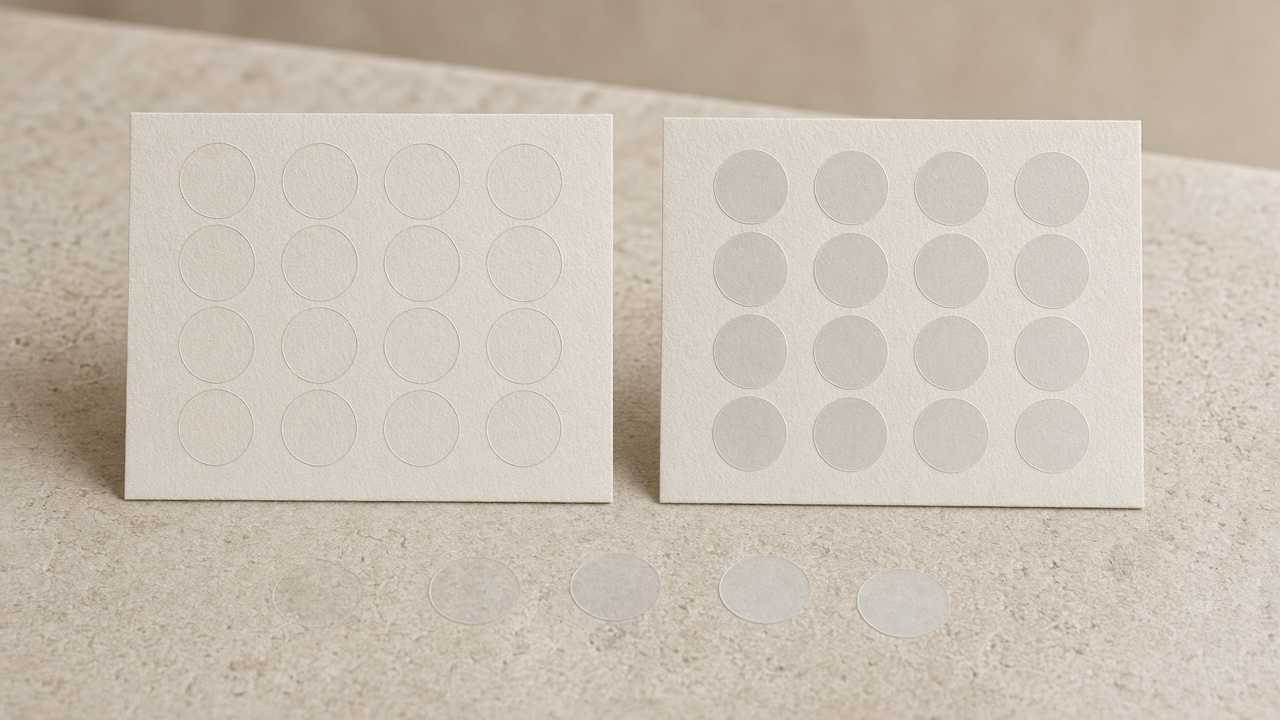
The job on the shelf is to pick the right bulk of hydrocolloid, not a second format. A thin daytime disc and a thicker overnight disc are the same sticky dressing. One sits flatter for work. One takes a bit more rub from a pillow. The carton is where those two get mixed up.
Hydrocolloid collects fluid from a whitehead, an open spot, or anything already weeping. On this site that format sits around 15–40p a patch. A closed early bump is a different buy. Anything deep, painful, cystic, or recurring is a GP visit, not a thicker sticker. If you are still choosing a format, start with hydrocolloid vs microdart.
Thickness is not the same as size
UK packs print two different facts on the front.
Diameter is how wide the circle is. Thickness is how much the disc stands off the skin. A wider disc is not a night disc.
COSRX Master Patch is a 24-patch mixed-size sheet, often listed around £5.99, about 25p a disc. Smaller circles and larger circles are width, not a thin sheet plus a thick sheet, unless the carton says so. Mighty Patch Original is one everyday size in a 36-pack, often around £10–12, or about £8.79 for 36 at Boots, nearer 24–33p. Check the retailer. One diameter does not tell you the plastic is the flat day disc or the bulkier night one. If the tiny dots never cover your spot, that is a size problem — the own-label guide is that test.
What the thin daytime disc is for
The thin disc is the one you can wear out of the house. It sits closer to the skin. You may still see a faint rim in good light. Foundation, if you use it, goes over the patch once the rim is stuck to dry skin. It does not go underneath. The makeup guide is that order.
It is still hydrocolloid. A white middle shows through foundation. Thin does not hide that. The white-centre guide is the colour.
The thin disc is a weaker choice for the pillow. A fringe, a beard, or the cheek on the pillowcase can drag a fine edge. Damp skin and cream still come first. The peel guide covers those.
Leave a comfortable thin disc on through the working day, usually six to twelve hours. If an edge lifts and will not reseal, bin it. Hydrocolloid is single use.
What the thicker overnight disc is for
The thicker disc is the same dressing with more bulk. It handles a little more rub from a pillow, or from hair across that side of the face. It also sits up. In daylight it reads as a plaster. Do not pile foundation on it. Keep it for bed.
More bulk does not collect fluid from a closed bump, and it does not stick to damp skin, serum, oil, or SPF on that circle. Wash the spot, wait until it is dry, skip cream on that circle only, and press the middle, then the rim. The overnight apply guide is the same steps for a thin sheet and a thicker one.
A white or cloudy centre means it collected fluid. A disc that stayed on and stayed clear had little surface fluid to take — a format clue, not a sticker that was too thin. The unchanged-bump guide is that morning. A thick disc that peeled on wet skin is still a hold problem. Try dry skin and a sealed rim before you buy a second thickness.
How to read the UK carton
Boots, Superdrug, and Amazon UK use the same words in a different order. You want hydrocolloid, and small spot discs you can peel off a sheet. Dissolving cones are the other format. A large blister plaster is a wound dressing. Put it back.
Do not trust the word overnight on its own. Many plain sheets say leave on overnight and are still a standard thin dot. There, overnight is a wear-time line — the same six to twelve hours — not proof the plastic is thicker. The split this page is about is a thin day sheet beside a thicker night sheet, sold as a pair, or labelled so you can feel the difference between finger and thumb.
Own-label at Boots or Superdrug is the same reading. The shop name is not the thickness. If the carton only says hydrocolloid spot patches and a count, treat it as an everyday disc. Do not pay above the 15–40p band for a night word you cannot feel as extra bulk. A thicker disc is not a dearer format. If both sheets feel the same, you are choosing diameter, count, and pence.
When neither thickness is the right buy
Do not buy a thin disc or a thick one for a closed early bump still under the skin. Hydrocolloid has nothing to collect. The next format, if you buy one, is a microdart, typically £0.60–£2.50+ a cone, so check the retailer. Stockists are on the microdart buying page. Do not put a cone on a spot that is already open or weeping.
See a GP if the spot is deep, very sore, cystic, or it keeps coming back. If you have already picked it, either thickness can cover the open bit. It cannot undo the squeeze. The picked-spot guide is that case.
Where to buy in the UK
Everyday hydrocolloid stays in the rough 15–40p band, though pack prices move. For a named mixed-size sheet, COSRX Master Patch (Amazon UK) is 24 patches, often listed around £5.99. Mighty Patch Original is the one-size 36-pack, often around £10–12, with Boots nearer £8.79 for 36, plus Hero UK and Tesco. Stockist notes are on where to buy hydrocolloid patches.
More notes sit in all guides. If you are still deciding between a cheap disc and a cone, use hydrocolloid vs microdart.